
Discos Peerless Discography
To view the Peerless Discography click here.
Discos Peerless, S.A.: A Label Discography
Introduction by Chris Strachwitz
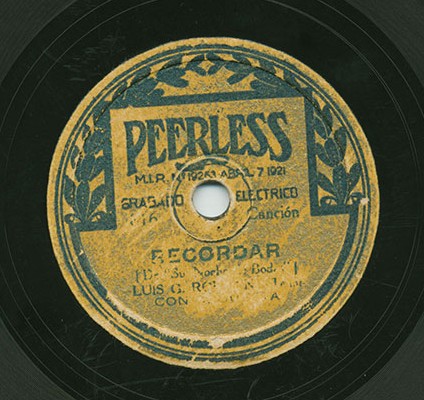
Discos Peerless S.A. was Mexico’s first major record producing and manufacturing firm. The Peerless label, probably under the ownership of Gustavo Klinkwort, first appeared around 1929 with a 7000 series, which included several releases by singer, composer, and pianist, Agustín Lara, who would soon become one of the major stars of Mexican popular music. Around 1931 or ’32, the label began an 800 series which soon introduced a new matrix series (probably starting with matrix #1N by release number 829). On Monday, August 14, 1933, the firm was incorporated when Mr. Klinkwort joined with Eduardo Baptista to form Peerless, S. A. It could well be that matrix #1N marked the beginning of this joint venture. The date of the incorporation is given in a special edition of “DiscoMexico” (Ano XII, #94, September 1983) devoted to the 50th anniversary of Peerless Records entitled “La Primera Compania Fonografica De Mexico: 1933-1983”. Eduardo Baptista brought considerable experience to the new corporation, as he had previously operated the Olympia (1926-27), Huici (1927-28), Artex (1927-28), and Nacional labels which had waxed Guty Cardenas and Tito Guizar among other rising stars.
By the time the Peerless corporation began, many of the early stars had already recorded for American Columbia and Victor. Both of these giant American firms, along with Edison, had begun recording in Mexico around 1904 and made several trips until 1909 when the revolution made such trips too dangerous. By 1926, Victor resumed field trips to Mexico and apparently had agencies in Mexico City and Veracruz that not only distributed records and phonographs made in the USA, but also searched for talent. Victor, however, did not feel secure enough to open its own production and manufacturing facilities in Mexico until around 1935. Columbia apparently never returned to Mexico to make recordings after 1908 since they discovered that there was plenty of talent north of the border. Columbia, however, also had established distribution in Mexico but did not build their own production facilities there until 1946!
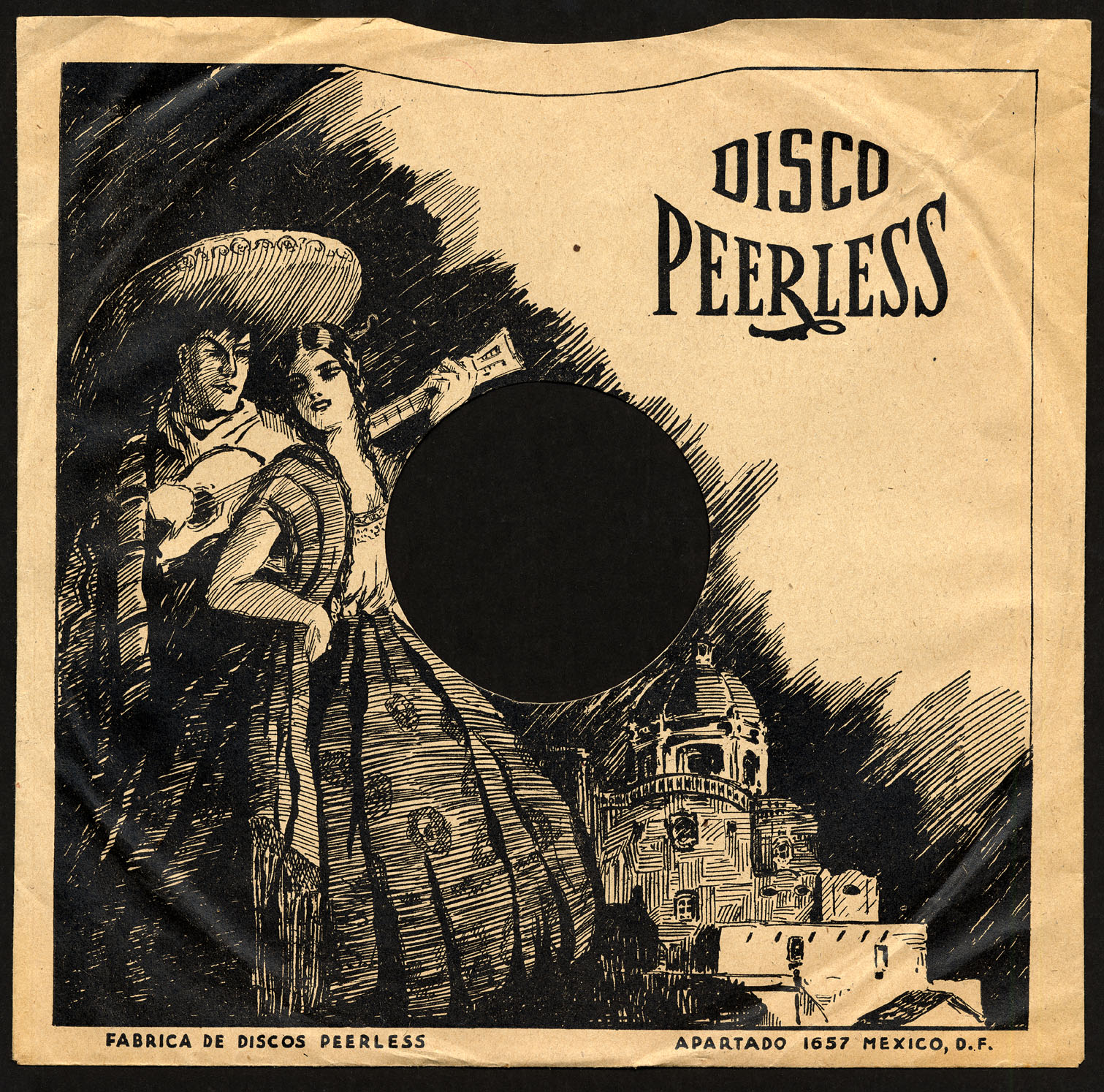 Affluent Mexicans who could afford to buy record players and discs were a small part of the population, and were supplied with not only the latest dance hits but also with Mexican music by American firms and their distributors. Peerless, although the only Mexican based record producing company, was handicapped from the start by being able to buy only obsolete American recording equipment and was only slowly able to improve its disc quality. The majors, then as now, were not anxious to help establish competition! Since most producers were also from the wealthy class, they only grudgingly and slowly acknowledged the fact that the tastes of the poorer and largely rural population eventually made record companies successful. Vernacular soloists, duets, and trios were soon outselling the operatic tenors so popular in the 1920s. Peerless eventually built up an impressive roster of stars in the realm of popular Mexican music, including Agustín Lara, Emilio Tuero, Las Hermanas Aguila, Pedro Infante, Lola Beltrán, Tona La Negra, Los Hermanos Zaizar, and Miguel Aceves Mejia, though few on an exclusive basis.
The first Peerless hit, according to Leo Porias (quoted in the above named publication) was in 1936 when Los Trovadores Tlalixcoyanos recorded “Camioncito Flecha Roja” (Red Arrow Busline -no doubt about the trials and tribulations of riding on a third class Mexican bus!) which allegedly sold 3000 copies. This was followed shortly by “El Barrilito” (The Beer Barrel Polka) recorded by the conjunto of the Dominguez Brothers, which sold 5000. Peerless finally hit real gold when, under the artistic direction of Don Guillermo Kornhauser, it recorded the soon-to-be #1 Mexican singing and movie idol, Pedro Infante, on November 5, 1943. Peerless has continuously released music of all types under that imprint to the present day, from semi-classical to regional – not only recordings of Mexican origin, but also licensed masters from other countries. Collectors of rock ‘n’ roll classics might be interested in Peerless 78 rpm pressings by the Rolling Stones, which were indeed available in Mexico in that format at that late date!
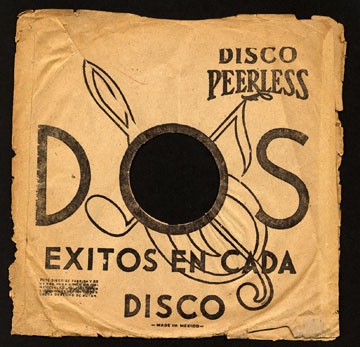
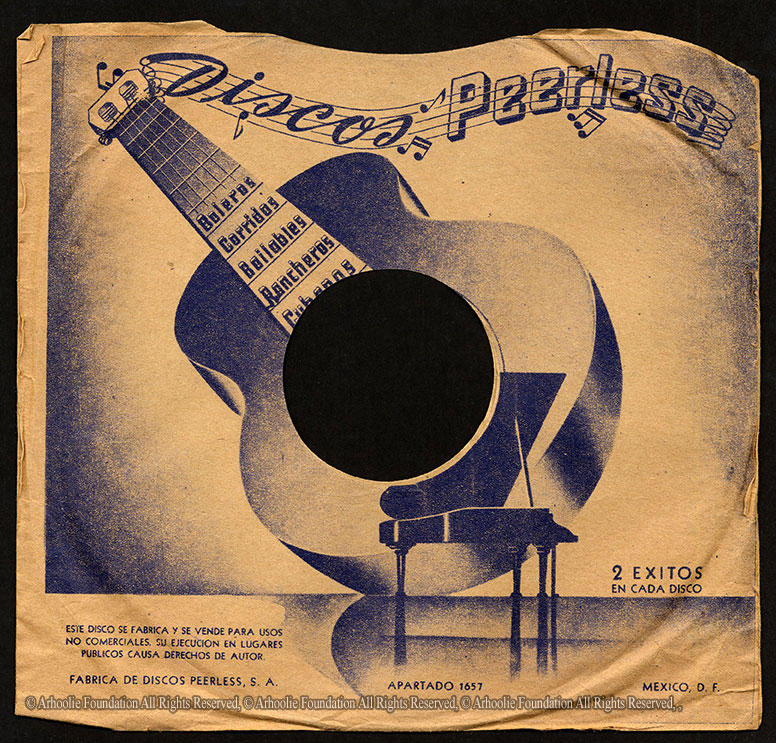
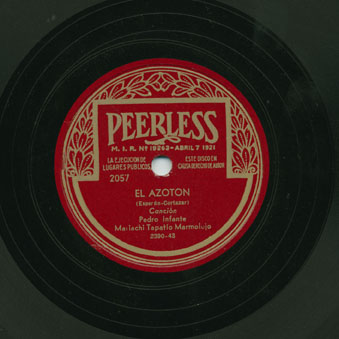 Unlike Victor and Columbia, which opened their Mexican branches in the mid-1930s and late ’40s, respectively, Peerless published few, if any, listings or catalogs of their releases until the advent of LPs (long-play records) in the 1950s. Collectors, researchers, scholars, and fans of Mexican music have long been frustrated by the total lack of information available regarding early Peerless recordings. The only listings of releases I had ever seen were short lists of currently popular items printed on the sleeves of 78 rpm records. We were told that around Christmas time the label would sometimes run listings of their bestsellers in the daily press, but we were unable to confirm this, and of course matrix numbers were not given!
From past experience, I was aware of the fact that many record companies, especially in Mexico, are suspicious of anyone trying to obtain discographical information. They generally consider this confidential data because they feel it might reveal sales figures and/or royalty payments to publishers and/or artists, or the lack thereof. Fortunately, Jonny Clark, a mariachi researcher, brought a copy of one of Dick Spottswood’s monumental volumes of Ethnic Music on Records to show as an example of a discography: a catalog of all the artifacts or holdings (by matrix number) which a record company and/or the artists have produced, and therefore a valuable asset to all those firms who have ever found it financially or culturally rewarding to re-release older recordings.
 In 1994 a friend of mine, Prof. James Nicolopulos of the University of Texas at Austin, visited Peerless because of his intense interest in the corrido – the Mexican narrative ballad – and worked on an annotated catalog of all recorded corridos. He was kindly shown the Peerless card files by Natalia Gonzalez and, in the absence of a complete catalog, painstakingly began to dig through them for every listed corrido. Unfortunately, the plant claimed to have no information on any releases prior to 1939 when the company moved to their new, present facilities. They were also quite sure that no printed catalog of the label had ever been seen! A number of Mexican and American record collectors also expressed their frustration about not knowing precisely what Peerless had produced over the years. I began to make plans to approach Peerless about the possibility of cataloging their productions.
In the summer of 1995, under the direction of Prof. James Nicolopulos, Jonny Clark and I requested permission to document the early years of the Peerless label. The head of the royalty department, Natalia Gonzalez, whom Prof. Nicolopulos had met the previous year, invited us to consult the documents in her office, but we had not received a formal invitation from the head of the firm. We figured it was now or never and left for Mexico determined to document the label as much as possible. Fortunately, shortly after our arrival, we were able to meet with the then president of Peerless, Ing. Jurgen Ulrich, who was born in Mexico but educated in German schools and fluent in that language! Due to my sad lack of proficiency in Spanish, we had a fruitful conversation in German about the importance of documenting the holdings of a firm such as Peerless. When Mr. Ulrich saw the impressive work done by Richard K. Spottswood in documenting ethnic recordings made in the United States, we were welcomed to begin our task with his complete cooperation. Mr. Ulrich personally gave us a tour of the large plant and showed us all the documents and artifacts still in existence. He also showed us the archives where the tapes for most LP releases were stored, and a rather messy room filled with metal matrixes that did not seem to be sorted. Examining a few here and there, we soon determined that they did not include any pre-1939 items.
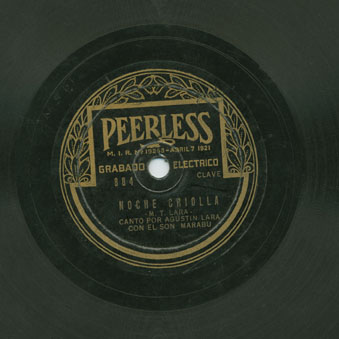 It quickly became clear to us that 1939 was the year when the in-house documentation of the Peerless label began. The firm moved to its present large facility that year, began a new matrix series (139, the latter number indicating the year the recording was made), and began life anew by releasing Peerless #1501! The last known release number pressed in early 1939 at the old plant is probably Peerless #1369, and we can assume that no further releases exist in the 13 and 1400 series. There seemed to be absolutely no records of any kind left dealing with pre-1939 recordings. I happened to look into their card index in the royalty room and the very first card revealed the bad news, which stated that all metal masters had been melted down because of the recordings not having been well recorded. Some items, however, from the period 1939-1946 apparently became steady sellers and were re-recorded or new stompers made from the mothers. The same card also indicates that all metal matrices through September 24, 1946 were melted down as well.
Back to our tour of the Peerless plant: A very small room, partitioned from a larger space, contained the most interesting artifacts from my standpoint – namely 78 and 45 rpm discs pressed by Peerless after 1939. The run of Peerless pressings seemed to be complete, in chronological order, neatly stored in albums holding about 10-12 discs each. All discs were in mint condition – file copies – one example of each. On one shelf I discovered samples of pressings made by Peerless but not necessarily issued by them. These albums of 10-12 discs each contained rare custom pressings, including some of corridos which on occasion had a picture on the label of the politician in whose honor the song was composed. Some albums contained samples of other labels manufactured by Peerless, including a few later ORFEO items and some on the TEXAS label. Although we began to obtain our data mostly from the 78 rpm record labels themselves, taking the matrix numbers from the lead-out grooves, this soon proved very time-consuming. Fortunately, Peerless prints their matrix numbers as well as the catalog number on the record labels. When we got back to the office, Ms. Gonzalez discovered to our delight that books of label copy existed, and so the bulk of the catalog information and data was eventually derived from the label copy for each disc. The new and very logical matrix formula initiated in 1939 assigns consecutive even numbers to all masters beginning with the number 2, followed by a dash and the last two digits of the year of the recording. Some masters were licensed from the United States or other sources, but it seems that no older or pre-1939 Peerless masters were re-issued since they had indeed been destroyed. I did however find one box with approximately 30 older Peerless items which someone had obviously saved because of the famous names of the artists. The matrix numbering system continued up to the end of the 78 rpm era, in the late 1950s. In a few instances, alternate takes were issued. Odd-numbered matrices represent these.
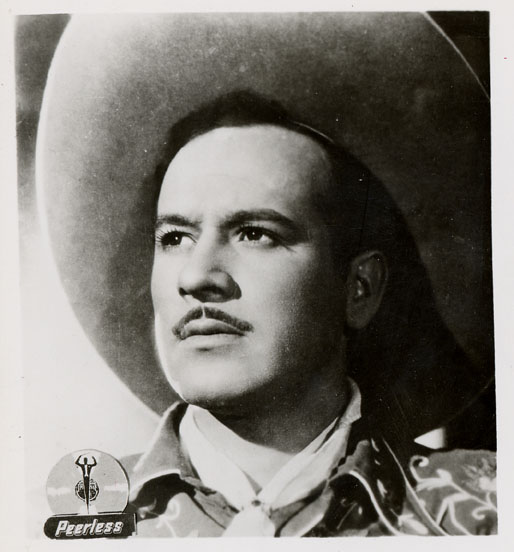
The other interesting artifact which survived is a set of original, handwritten log books. Book #1: 1945-1950 (matrix 3264-45 to 8592-50); Book #2: 1951-1954 (this book was missing); Book #3: 1955-1958 (matrixes 13602-55 to 17862-58). Since we were unfortunately unable to xerox these fascinating recording logs, Jonny Clark did begin transcribing some of the data from book #1, but it was a slow job and was abandoned when I mentioned that our prime effort was to complete the basic catalog. These log books contain exact recording dates, often names of accompanying musicians, matrix numbers, and alternate take (if any). They also show interesting hand-drawn diagrams about the location of mikes, and even cutter head readings and other technical data for each session. The volume which included the first recording session of Pedro Infante was missing, much to the concern of Mr. Ulrich and the man in charge of the archives. Unfortunately, without these log books no complete and accurate discography of Pedro Infante, or any of the other artists, can ever be completed. Jonny Clark, who stayed on the longest, supervised data entry through release number 2391 (recorded and released in 1943). The bulk of the entry work was done for us by Ms. Alicia Cornejo of the Peerless office, who did much of the entry work after hours and at home at a very reasonable rate. She seems to have been very accurate and careful in her work. Our deepest thanks go out to her.
 Since the Peerless catalog prior to 1939 was not documented by the firm and since no records of any kind—other than a handful of 78s—exist at the Peerless offices, we turned to Mexican record collectors for help. The main bulk of pre-1939 Peerless catalog information was generously made available to us by Armando Pous, probably Mexico’s leading record collector, who has spent years painstakingly assembling this information primarily from the actual discs in his collection. Special thanks also go to the late Jorge Miranda, who had an extensive collection which was recently acquired by Mr. Pous. However, as you can see, the pre-1939 Peerless catalog still has many gaps. We hope that collectors who have items for which our discography lacks data will send us all details and thereby contribute to the eventual completion of this first part of the Discos Peerless discography, which currently stops in 1955 with release #4948, which is not far from the end of the 78 rpm era.
Notes:
This label discography begins with a number of 78 rpm pressings which show no catalog or release numbers. We found these single file copies in the Peerless archives and most of these appear to be custom pressings of limited circulation, probably not commercially distributed. Many of these, however, would appear to be of historical interest. In some cases, the label shows a picture of the political candidate about whom the corrido on the record had been composed. The matrix numbers indicate what we saw written in the wax of the lead-out grooves.
The last known release number from the old plant is Peerless #1369 from early 1939, and we can assume that no releases exist until the first release from the new plant (#1501) with new master numbers.
To view the Peerless Discography click here.
[feather_share]